glazed terracotta
45x45x23 cm
2024
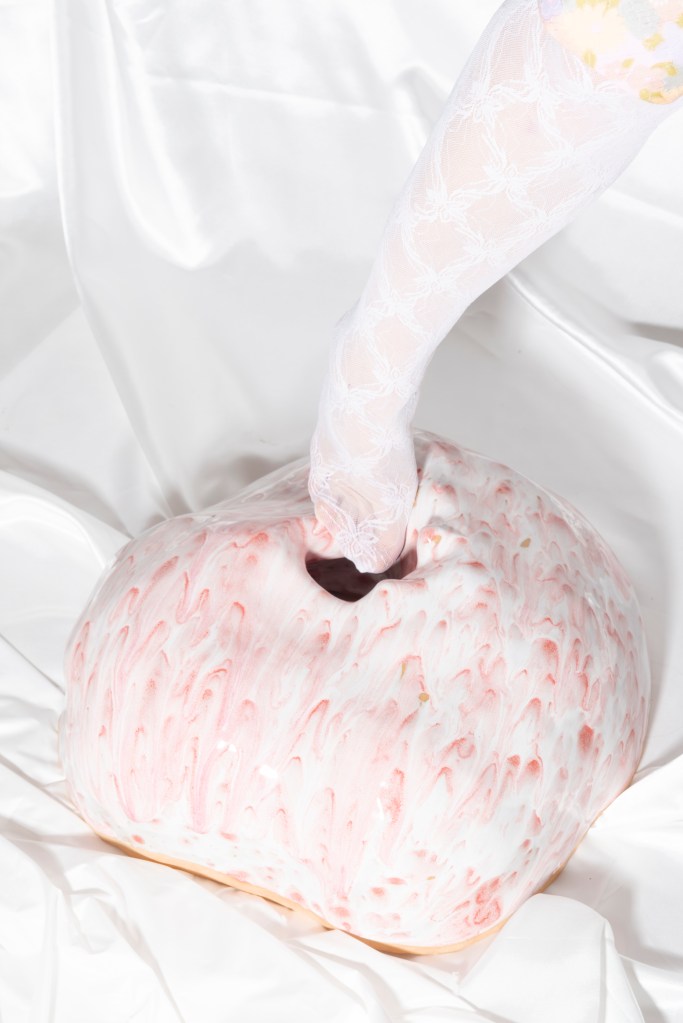
A Cielo Chiuso is a work in glazed ceramic. The sculpture, a single umbilical body in the centre, immediately conjures up the image of a belly, a round, soft and feminine belly. The title is borrowed from an expression used in surgery that refers to operations performed through minimally invasive access and therefore without exposure of the internal environment. Through the central slit, the viewer becomes the spectator of a singular ‘intervention’ of introspection: on the sequences of a laparoscopic cholecystectomy surgical procedure, fragments of childhood films scroll by. Through the superimposition of frames, the narrative of an introspective analysis is thus constructed: the anatomy of a woman’s body merges with the anatomy of the artist’s memories, both observed from an internal perspective. Laparoscopy, surgically understood as both an exploratory/diagnostic and therapeutic means, metaphorically becomes the vehicle for such insight. On the other hand, it can be argued that introspection, like the laparoscopic technique, is as much
minimally invasive as it is disruptive in its outcomes: it accesses the subconscious through small breaches to overturn the ego’s scaffolding. A Cielo Chiuso, in 5 minutes, wants to induce the viewer to look inside himself, establishing a causal link between the fragments of his own experience and the structure of his emotional anatomy.
VENERE!
glazed terracotta
43x28x28 cm
2024
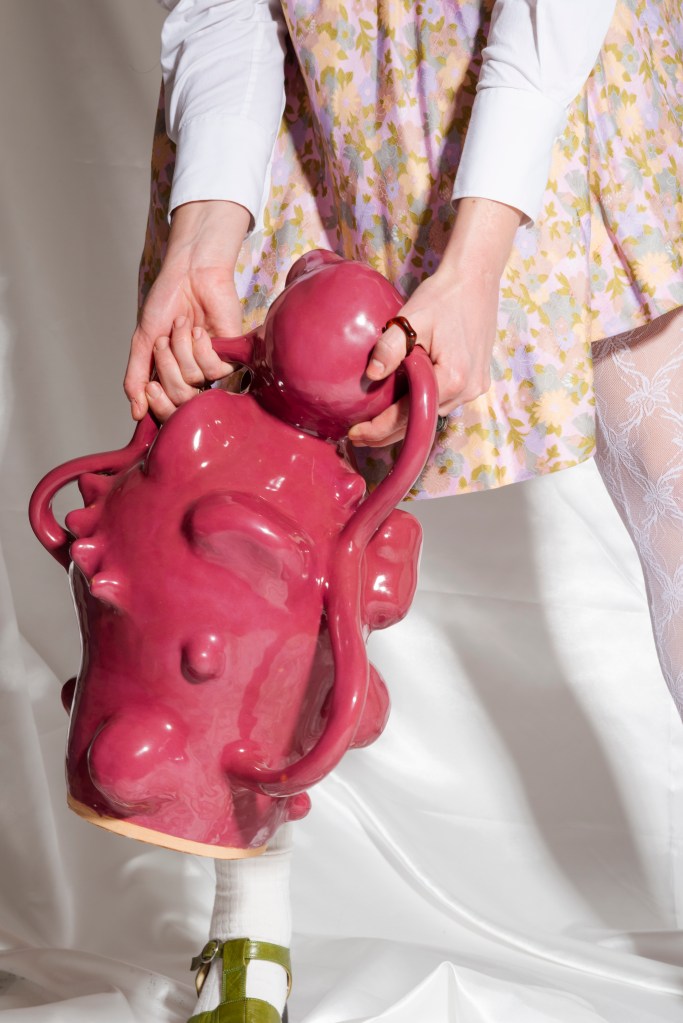
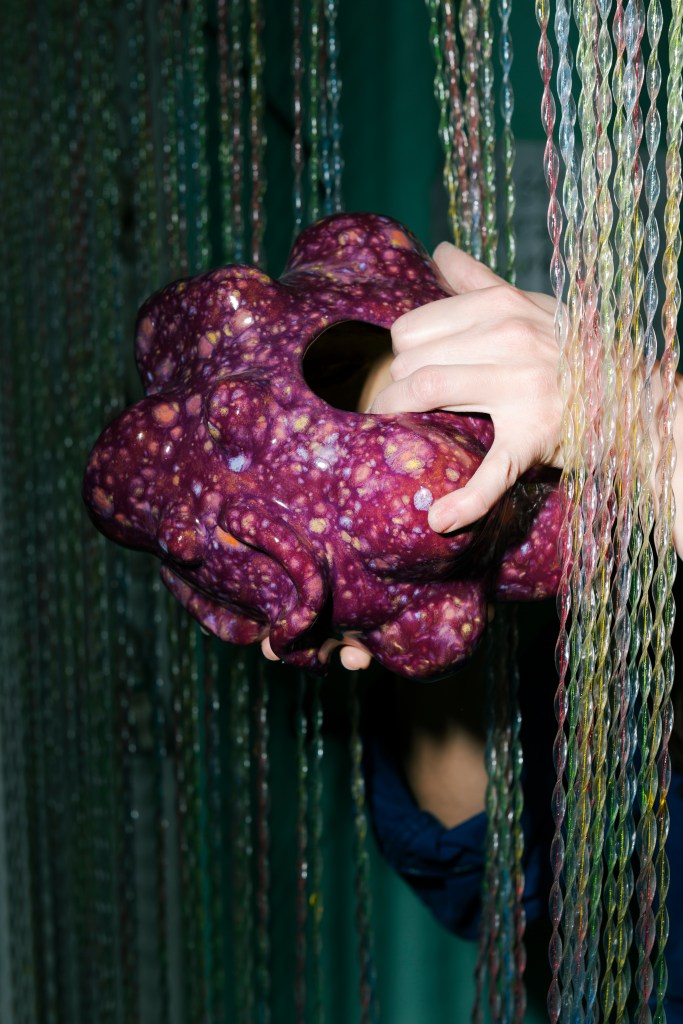
VENERE! is a work made of terracotta using the colombino technique. The sculpture is articulated in a single block, in which the sketches of a head and a body can be recognised, and in two cordoniform elements that act as a bridge between the two segments.
Right from its title, the work evokes the tradition of Palaeolithic Venuses, generic and anonymous representations of femininity, widespread among prehistoric cultures as objects with magical and propitiatory significance. Small and compact statuettes, so that they could be easily transported by nomadic peoples, Venuses were depicted as buxom women with pronounced sexual attributes, but their heads and limbs rudimentarily hinted at. In VENERE! femininity is suggested by shy sinuosity, while breasts and hips are not clearly discernible. Instead, bumps and knots emerge from the soft volumes that seem to lift the surface like under-skin nodules. The ceramic material, solid and dense, becomes a thin veil through which transpires the suffering of the body that arrives at extreme deformation in response to the need to contain what would otherwise overflow: the trauma of objectification, the violence of categorisation and the finalisation of female corporeity. Deformation is understood as a metaphor for somatisation, an exquisitely human phenomenon that consists of rendering organic – hence projecting onto the body – a psychic conflict, with manifestations on the various apparatuses. Unlike Palaeolithic women – almost microcephalic -, in VENERE! the head has its own specific weight: its reclining pose does not tell of self-pity, but introspection and self-awareness. The two cords also create an obvious conjunction between head and body, two power units attentive to absorbing and processing input from the outside world.
The chromatic choice of the enamel, an intense magenta, is not accidental. It distantly echoes the red ochre attributed to the original features of the Venus of Willendorf, but above all the fuchsia-violet of the feminist struggle. VENUS! conceals, finally, in its title a further level of meaning: the vulgarity, here made explicit by the exclamation, of the coarse and often sexual appreciation to which the woman as a woman is subjected.
FUOCO CAMMINA CON ME
glazed terracotta
33x25x28 cm
2024
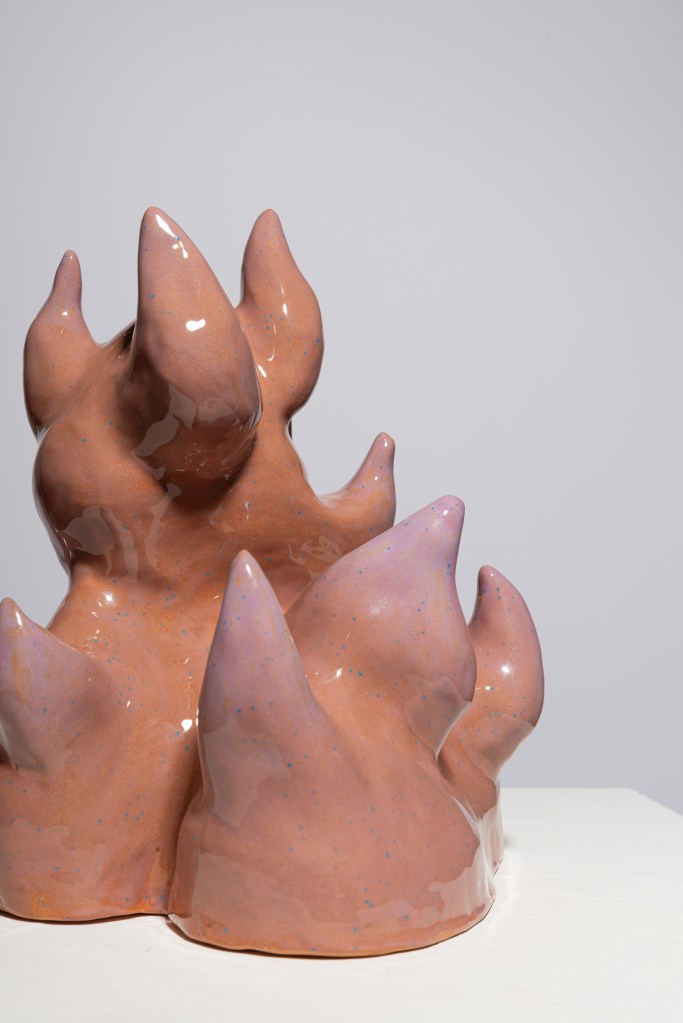
Fuoco cammina con me is a sculptural work made of glazed terracotta using the colombino technique. The artefact reproduces a living fire whose flames project upwards towards the sky. It is a pink fire, a fire of struggle, a fire of friendship and sisterhood.
The work is inspired by the symbolism adopted by the Non Una Di Meno movement in its fight against the Feminicides Lesbicides Transcides that set fire to homes all over Italy every year. Between 8 March 2023 and 8 March 2024 there were 114 homicidal gender events, as reported by the NUDM Observatory. These events are the result of systemic violence exerted on the lives of women and all the free subjectivities that escape the imposed gender norms and that – data in hand – almost always take place within domestic walls or emotional ties. Mothers, daughters, sisters, partners, not numbers, are the subjects of such violence. The flame portrayed here is dense with historical references: it is the domestic hearth whose reassuring warmth is here overshadowed by the meanness of violence; it is the fire of the martyrdom of so many female personalities torn from life because they were free and did not conform to the rule; it is the fire of the Phoenix reborn free from its own ashes, Post fata resurgo, that is ‘after death I come back to rise’; but it is also a fire of alarm, a call for help. The title, Fire Walk With Me, a quotation from David Lynch’s famous film, as well as the motto of the feminist and trans-feminist struggle, is meant to be an exhortation, an invitation to courageously join these flames so that darkness does not fall on such an epidemic emergency as gender violence.
LA GRANDE MADRE
Grés and pink glaze, 40X24X26 cm
2024
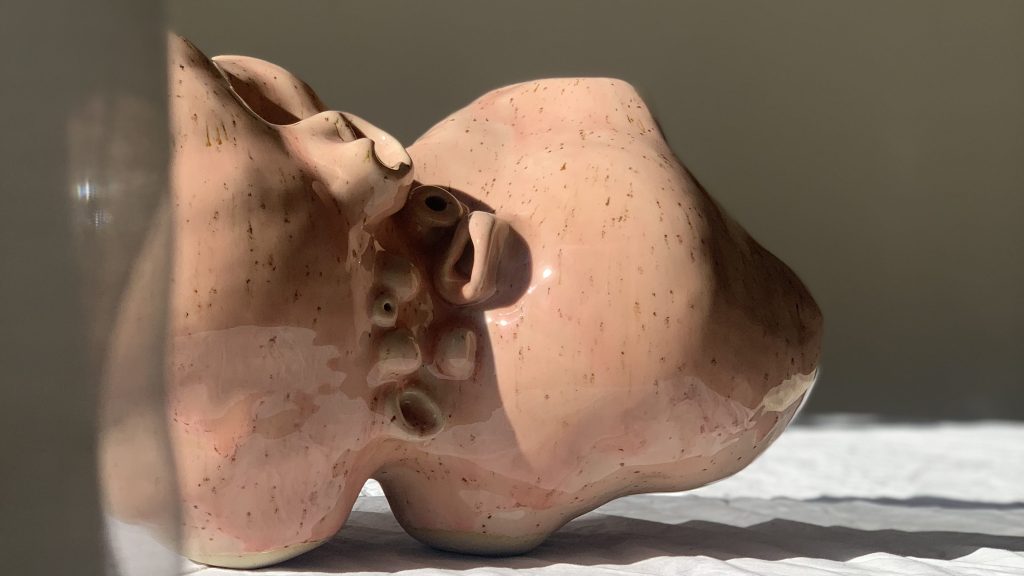
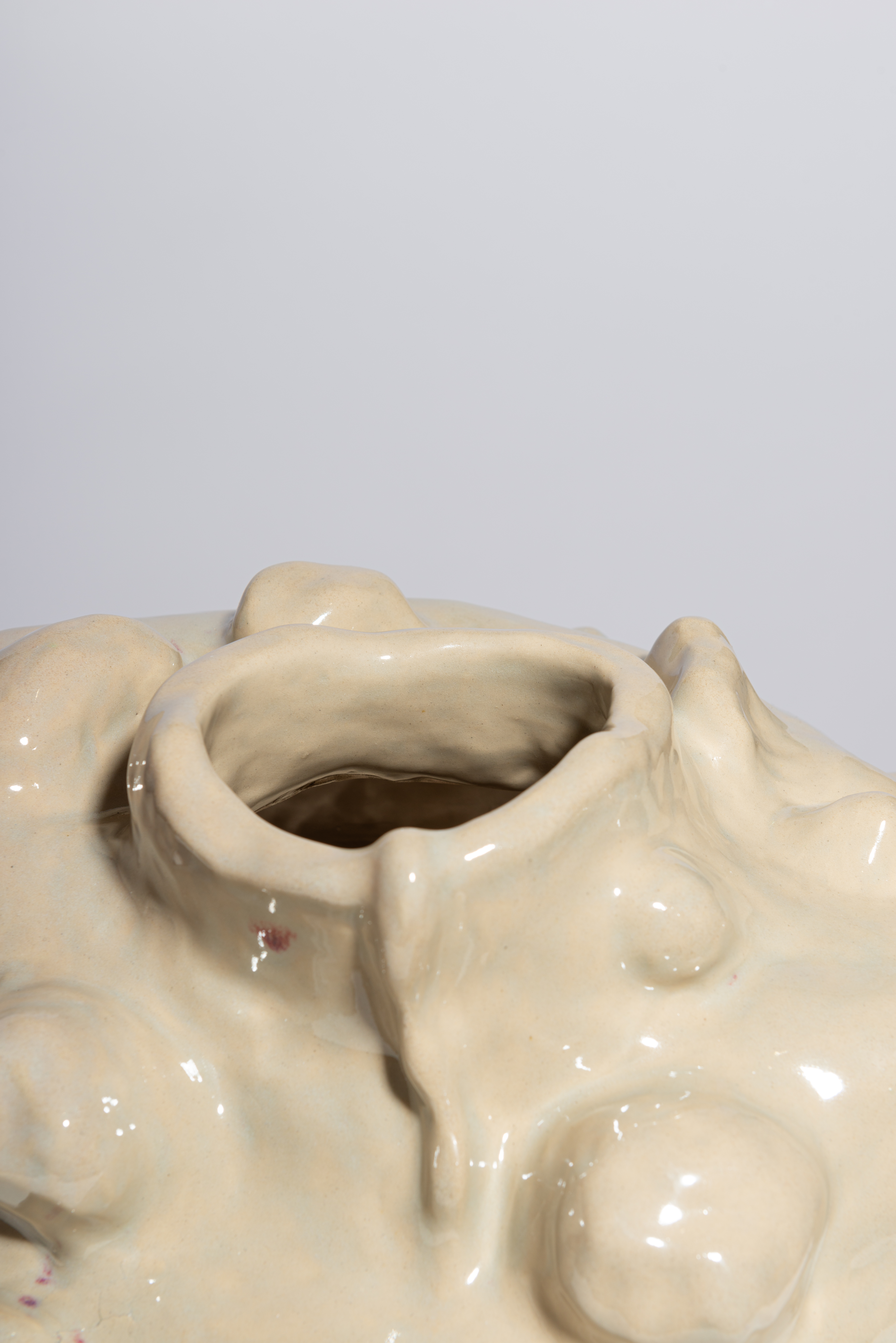
La grande Madre is a sculptural work made of enamelled stoneware. The title recalls the figure of the generating divinity that appears in the myths and religions of ancient civilisations, crossing epochs and latitudes. Connected to the cult of Mother Earth, she represented the interminable cycle of birth-development-maturity-decline-morterigeneration. The work also draws on the imagery evoked by the Kingdom of the Mothers in Goethe’s Faust, described as an underground place where what appears in the physical, earthly world is generated, and narrates the here and now of humankind. The sculpture is presented as a single but bipartite body: two volumes of different heights converging at the centre, generous as feminine hips. At the point of conjunction, rounded formations emerge from the surface, some umbilicate, evoking the image of animal nipples. The Great Mother, mythologically interpreted as divine rocreatress, arbiter of the cycle of life, is represented here by a form at once powerful and empty. The mother’s belly, almost bovine, is a frighteningly orbid cavity, the breasts are dry. There is no life inside it and no possibility of life outside. Not cradle, but spectral cavern. The choice of enamel is not accidental: a pink with a visceral hue, reminiscent of the warmth of the mother’s womb and the organs typically associated with nurturing, and which here stands in a disturbing relationship with the sculpture itself, reinforcing the ‘life-death’ binomial that underpins Nature’s dynamic equilibrium. ‘The Great Mother’ continues an established artistic tradition of depicting Nature, understood in this case as Planet Earth. The narrative is, however, false and tendentious: the prosperity and abundance communicated
by the forms are contradicted by the empty spaces that the volumes leave imagined. The false becomes a tool to tell the true: a planet turning towards its surrender, emptied of raw materials, bloated with waste.
RELIAQUIAE
Grés and pink glaze,
15X13X5 cm and 15x12x6 cm, 2024


RELIQUIAE is a pair of sculptural elements made of glazed stoneware that reinterprets the theme of the sacred object. The relic, a term derived from the Latin word reliquiae-arum, ‘leftovers, remains’, which in turn is linked to the verb relìnquere, i.e. ‘to leave behind’, is by definition what remains of a subject endowed in the eyes of a community with lofty or even superhuman qualities. Its use as a magical object has been witnessed since the earliest human civilisations and persists to this day as an instrument of devotion in the so-called universal religions, often in the form of body parts or objects that belonged to the subject deemed divine.
SPOLIA
Grés and neutral glaze wrapped in reused plastic
20x15x15 cm, 2023
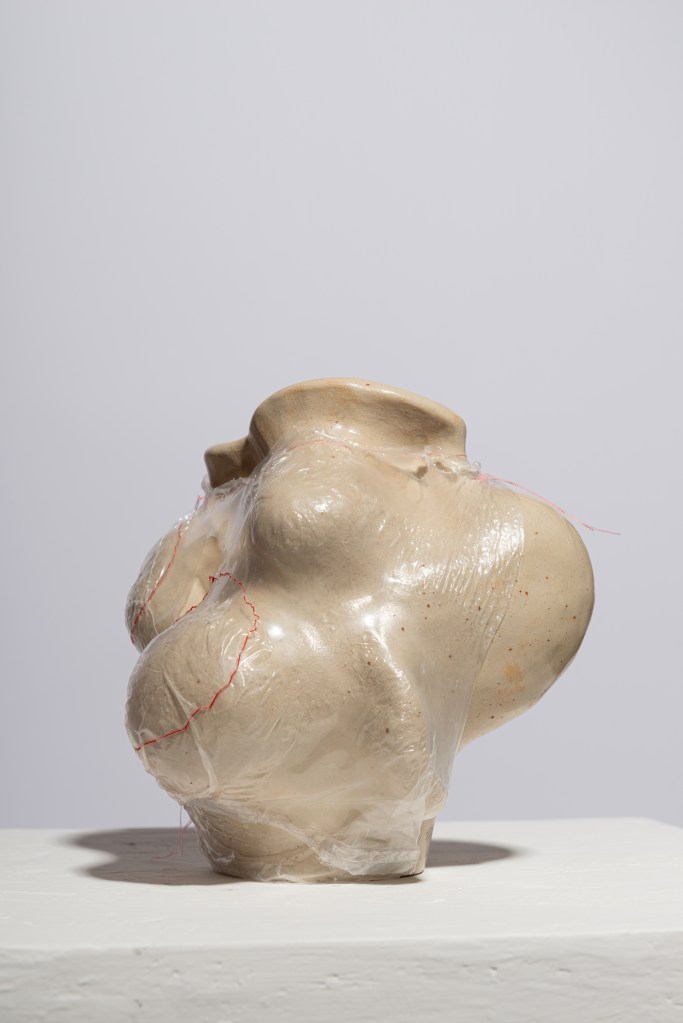

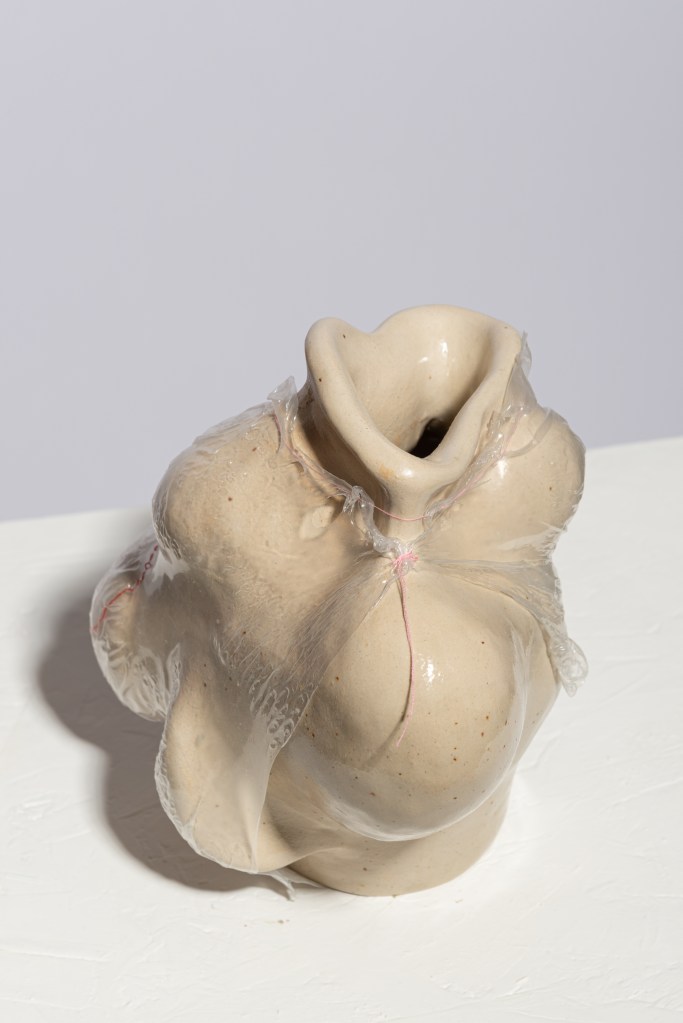
In SPOLIA the plastic potential of the material is exasperated in bumps and knots that distance the object from the archetype of the vase and from a possible everyday use. Deformities emerge through the transparencies and adhesions of the membranes that contain it: reused plastic and gut. The work, whose title refers to the Latin word spŏlia (pl. of spolium), literally the envelope made up of the horny layer of skin that some reptiles abandon every year at the time of moulting, and from which the word spoglia, meaning dress, envelope, but also corpse, is also derived, is a metaphor for th e passage of Man on the planet. The sculptures, ghostly containers enveloped in materials historically used to wrap, constrict, contain, preserve, have a metaphorical value. As changeable as a reptile, Man has too often left traces of himself by abandoning his ‘spolia’, the result of an excess of production. The epilogue to which he is, however, destined is that of becoming entangled in his own discards, to the point of becoming totally identified with them. On the other hand, as Feuerbach theorised, <<Every individual is made of the matter that surrounds him>>.
BLOBS
 GINA BABIĆ